Showing posts with label Surname: LUIJENDIJK. Show all posts

Netherland's Stained Glass Windows-Those Thursday Places

Author: Brenda Leyndyke / Labels: ,


Stained Glass Window at the Dutch Refromed Church in Vierpolders, Netherlands

Previously, I wrote about the church in Vierpolders, Netherlands that our Luijendijk ancestors attended.  This church has beautiful (at least from the pictures I have seen) stained glass windows.  One window in particular is important to the Leyndyke family.  My genea-friend, Tom deMeijer, traveled to Vierpolders and visited the church and took pictures.  This is what he wrote about the windows:

The window was donated to the church, together with 5 other persons, by Jan Cornelisse Leuijendick in 1721 when the little church was built.

In the window with the 6 Coats of Arms.
Left top down:
 
Crins Janse, alderman-sheriff of Nieuwland (New Land of Brielle was the old name of Vierpolders), the cow indicates he had cattle.

Jan Hoogerwerf
Vasal of Voorne, sheriff of Vierpolders and Swartewael (now Zwartewaal, a village nearby) with fish and star.

Leendert van Doorne, Alderman, arms with merlon/ battlements; this indicates an old origin of his coats of arms maybe form the chivalry period.
 
Jan Cornelisse Luijendijk Portion of the Window

Right top down:Jans Cornelisse Luijendijk-Captain and Sheriff living in 1721; The Coat of Arms contains a grapevine and is inspired by John:15 "and Jesus said, I am the true grapevine and you are the vines; who stays in me and I in him, will bear many fruits".

Leendert Meuldijk (means mill dyke), so he was running a mill on the dyke. He was captain (of the warship) and alderman.

Sir Pieter de Boo; arms with sun, three trees and three swords. He was secretary of Swartewael and Vierpolders.

In the upperside of the window;
The Lady of Justice with her balance on the left and the Lady of Wisdom with mirror and snake to the right.

Thank you to Tom for providing us a glimpse into the past.  Kirk and I hope to visit the Netherlands some day and the church at Vierpolders will be on our list to see.

Dutch Reformed Church, Vierpolders, Netherlands: Those Thursday Places

Author: Brenda Leyndyke / Labels: , ,

 Dutch Reformed Church
Vierpolders, Netherlands

Dutch Reformed Church
Vierpolders, Netherlands

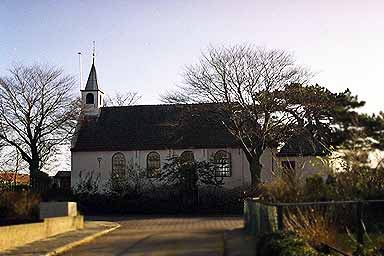
The Dutch Reformed Church in Vierpolders, Netherlands was built in 1721.  This church is the one that Jan Cornelisse Luijendijk, the son of Cornelis Arend Luijendijk-Kirk's eight great grandfather, helped found. 


Tom deMeijer, a Netherland's genea-friend told me, "It is not more than a chapel really, but very nicely situated on a higher part in the middle of the village between old trees and very well restored.  Besides the church,  you will see the old pulpit (original of 1721) and the State Bible offered to the church by Lady C.A. van Salis de Marcheling, born Baronesse van Leyden.  The organ is not original, but a recent copy of an organ as used in the early 18th century."

He explained the Dutch Reformed Church also, "In the Netherlands we distinguish the Dutch Reformed Church (Nederlands Hervormde Kerk) and the later separation, the more orthodox "Gereformeerde Kerk".  Both words "Hervormd " and "Gereformeerd" translate as "Reformed" in English.  The "Hervormde" branch was a more liberal form of Calvinism, but since a couple of years both churches have merged again.

The Migration of the Luyendyk's

Author: Brenda Leyndyke / Labels: , , , ,

One of the fun things about researching family history is delving into the reasons people leave their home country and immigrate to the United States.  I find this fascinating whether it is my family I am researching or my husbands.  

Pieter Luijendijk, Kirk's great, great grandfather, was born 29 August 1823 in Zuid-Beijerland, Zuid-Holland, Netherlands.  He was the twelfth generation of Luijendijk men who lived in Zuid-Holland.  I was curious what would make someone leave such strong family ties to the area and set out for the United States.

To understand his reasoning one needs to understand the history of the emigration in that period. Tom deMeijer shared the following with me, "Both Pieter and his father Jacob are known as “workman”.  They were part of the rural upper class of that time, with official positions as deputy mayors, sheriffs and “dijkgraaf” which is the highest authority in each polder.

What happened? In the period after the Napoleonic wars ending with the battle of Waterloo in 1813, the population in The Netherlands was growing exponentially. After the Congress of Vienna, the Southern Netherlands (now known as Belgium and Luxembourg) were united with “Holland” under the Orange monarchy. The population initially got work, energy and children, a lot of them. In the previous period the land was attributed to the elder son or daughter and the others made sure that they married a wealthy farmer or farmer’s daughter as well. With the explosion of the population these options became increasingly scarce. At the same time there were no good alternatives yet. It was too early for the industrial revolution that started only after 1870 (that could have absorbed a lot of people) and there was no fertilizer yet, allowing more intensive agriculture. Result was impoverishment all over, rather than the improvement of conditions hoped for after the wars."


The reason Pieter stated for emigration was "improvement of existence".  Like many others from many lands, he thought the United States would give him a better life.  In 1849, at the age of 26, Pieter and his wife, Jaapje (Maasdam) emigrated to the United States.

Source: "Dutch Immigrants to America, 1820-1880," database, Ancestry.com
(ancestry.com : accessed 19 May 2007), Entry for Pieter Luijendijk.

Pieter and Jaapje Luijendijk settled in Owasco, Cayuga, New York for a time.  They can be found in the 1850 and 1860 U.S. Federal Census in Owasco.  Jaapje's brother, Johannes, settled in this area, too.  Sometime before 1870, Pieter, Jaapje and their seven children migrated to the Grand Rapids area of Michigan.  I don't know the reasoning for this move, but do know that the Grand Rapids area is heavily populated by Dutch people.

The migration of Pieter Luijendijk took him from Zuid-Holland, Netherlands to Owasco, Cayuga, New York to Grand Rapids, Kent, Michigan.  A journey of almost four thousand miles.  I hope he found the better life he was looking for.

Luijendijk to Luyendyk to Leyn Dyke to Leyndyke: Surname Saturday

Author: Brenda Leyndyke / Labels: , , , ,

The Luijendijk name originated in 1470 on the island of Hoekse Waard, Netherlands.  The name is directly related to the life and work in the polders of ancient Holland. 

Luijendijk means the lazy dyke.  It is the second dyke behind the one that protects the polder from the invasion of sea or river water.  It is not the "active" dyke, hence the word lazy (or luie/luye dijk).  The family lived near such a secondary dyke, when people started to adopt family names.

Luyendyk is the more common American spelling of the surname.  Although no one is certain of the change in spelling, one can infer the the ij was changed to y, when ij is written it is almost identical to y.

Leyn Dyke is the spelling my husband's grandfather, Peter, adopted.  Peter was five years old when his father, Cornelius Luyendyk died.  His mother, Nellie, remarried Addison B. Kennedy.  Peter used the surname Kennedy until he was older and wanted to take his father's surname back.  He was unsure of the spelling so he spelled it Leyn Dyke, with the capital D.  Peter continued using this spelling until his death.

Leyndyke is the spelling my husband's family uses.  Kirk's father, Jim, changed it during his time in World War II.  During the war, Jim wouldn't receive all his mail as it was called to Jim Dyke.  He dropped the capital D and Leyndyke was born.

Here is my husband's Leyndyke lineage:

Kirk Leyndyke
James Leyndyke
Peter Leyn Dyke (1894-1991)
Cornelius Luyendyk (1859-1900)
Pieter Luijendijk (1823-1903)
Jakob Luijendijk (1789-1834)
Klaas Luijendijk 1745-1829)
Jacob Christiann Luijendijk (1708-)
Christiaan Corstiaan Luijendijk (1678-)
Corstiaan Cornelis Luijendijk (1648-1707)
Cornelis Arend Luijendijk (1618-1701)
Arend Jan Luijendijk (1583-1647)
Jan Arend Luijendijk (1556-)
Arend Jan Luijendijk (1530-1561)
Jan Arend Luijendijk (1500-)
Arend Luijendijk (1470-)

The First Luyendyk Immigrant

Author: Brenda Leyndyke / Labels: , , , ,

Source:  1850 U.S. Census, , Population Schedule, Owasco, Cayuga, New York,
p164A, dwelling 140; family number 151, Peter Loundick.

Pieter Luijendijk and Jaapje Maasdam immigrated to the United States in November, 1849.  The first United States Federal Census they would be in is the 1850 Census.  I had a hard time finding them as they are indexed under "Loundick".  I don't remember exactly how I found them, I may have found them in a later census living in the same place and scrolled through the Owasco 1850 Census page by page. 

The names found were Peter Loundick, Orphy Loundick, and Basty acon Loundick.  Their names were Pieter Luyendyk (American spelling), age 24; his wife, Jaapje Luyendyk, age 23; and their son, Bastian Luyendyk, age 8/12.  The ages given here were taken from the census image.  Pieter and Jaapje's birthplace was listed as Holland.  Bastian's birthplace was listed as N.Y. 

This census page was enumerated on 11 September 1850, just a mere ten months after Pieter and a pregnant Jaapje, stepped foot on American soil.  I imagine their dutch accent was pronounced enough that this is what the enumerator heard. 

From this first brave immigrant came many ancestors, whom I plan to share with you in the months ahead.